The Spice Must Flow
Inside the Money 20/20 moment when crypto stopped being the outsider and became the answer to AI, AWS outages, and the token economy


Last week at Money 20/20 in Las Vegas, we felt something had shifted. After years of being the outsiders looking in, we found ourselves at the center of the conversation. From Ribbit Capital’s groundbreaking token thesis to our packed Convergence dinner featuring Opacity, Clocktower Ventures, and others, the industry is now listening and coming to us for answers. Like Muad’Dib emerging from the desert to lead the Fremen, crypto has become the unlikely savior for an internet desperately seeking new business models.
This isn’t about disruption for disruption’s sake. It’s about convergence, where the established players who once dismissed us are now racing to understand how tokenization, self-sovereign identity, and decentralized rails will reshape everything from payments to personalization.
The spice must flow, and it’s flowing through new channels.
Read Nick’s recap from Money 20/20 here.
Convergence is brought to you by 321 Converge Inc. (“321”), a new 501c6 created by the founders of The Medici Network.
Integrations We Want To See 🔮
Now that we own our data, here are some things we’ll do with it

Sparks ✨
Quick, curated Web2 and Web3 insights you need to know
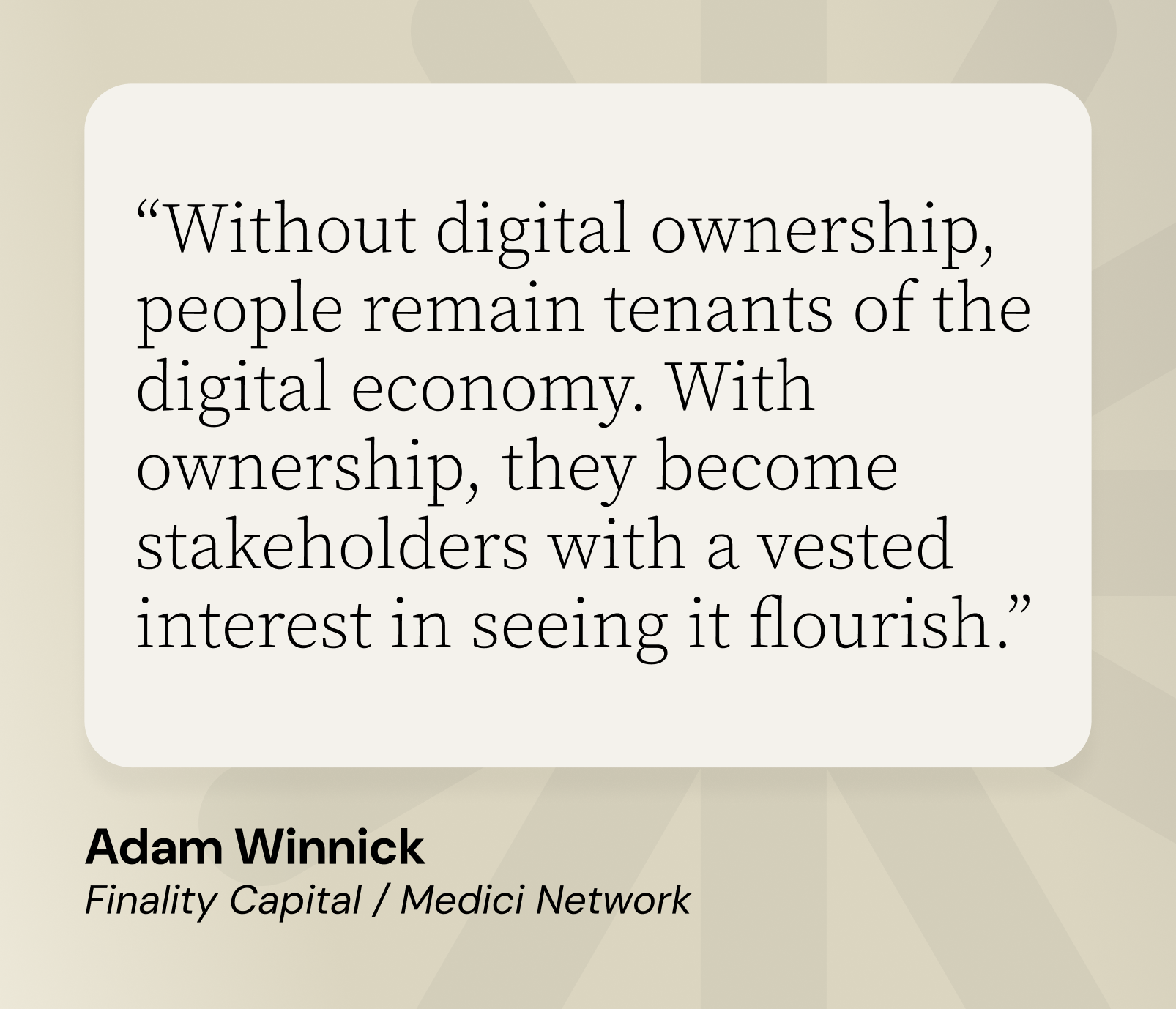
#1 Fortune Op-Ed: AI Is Gobbling Our Personal Data - but New Advances in Blockchain Can Stop That
Author: Adam Winnick (Co-Founder of Finality Capital Partners, Founder of The Medici Network)

TLDR:
The American dream of ownership is slipping away for homes and data too. AI agents vacuum up content without attribution, while we end up creating even more valuable private data through ChatGPT prompts
Two blockchain pillars fix this: verifiable data (proving facts about yourself without handing over everything) and verifiable compute (cryptographic guarantees that software runs exactly as promised)
Companies like Opacity Network are already helping with the verifiable data portion, while EigenCloud is helping with the verifiable compute. Additionally, Stripe acquired Privy to embed 80 million digital wallets, and Google partnered with 60 companies on a protocol for AI agents to pay for things using stablecoins
Our Takeaway:
Performance marketing is being rewritten for the agentic web. Instead of optimizing for clicks and conversions, we expect to see new metrics that optimize for data and outcomes (possibly data ARPU and task success rate)
Verifiable compute collateralizes trust into an economic primitive. Economic stake capital and slashing can offer provable, insurable reliability. We see this as step one, but eventually evolving or expanding into a cryptographic-based trust
We’ve already ceded our agency to big tech by letting them control our data. When AI agents act on our behalf and take over the next iteration of the internet, we’ll lose our control and ownership of our data, and let the new kingmakers of the internet take advantage of us
#2 Amazon Cloud Outage Reveals Democratic Deficit in Relying on Big Tech
Authors: Dr. Corinne Cath (Head of Global Team Digital at Think-and-Do tank ARTICLE 19) and Don Lee (Digital Team at ARTICLE 19)

TLDR:
AWS us-east-1 went down and took chunks of the internet with it: Signal, games, media, and even government services
Centralized clouds create single points of failure: when one hyperscaler falters, speech and access stall
“Open” projects still ride “closed” infrastructure, shifting risk to opaque vendors with minimal accountability
Microsoft/CrowdStrike 2024 was the preview; Amazon’s recent outage confirms concentration, fragility, and little transparency
Our Takeaway:
Remember the Google Cloud outage in June 2025? The lesson still hasn’t sunk in. When a cloud giant goes down, it not only disrupts apps that rely on it, but it also impacts billions of dollars and the entire global population. Centralization of cloud providers is a systemic risk for the web
Blockchains matter here because they enable us to move from “trust the operator” to “neutral, open rails.” Until we do, every outage is a civics lesson: convenience centralizes; freedom replicates
#3 a16z’s 2025 State of Crypto Report
Authors: a16z crypto

TLDR:
This is the year the world came on-chain: BlackRock, JPMorgan, and Visa are all in now. Even Stripe bought Bridge, and Circle’s going public. The hostile regulatory environment flipped to supportive almost overnight
Stablecoins are handling $46 trillion in annual transactions (that’s a Visa/PayPal-level volume) at less than 1 cent per transaction. Stablecoins are also now the #17 holder of U.S. Treasuries, bucking the trend while foreign central banks dump dollars for gold
Blockchains have leveled up massively, processing 3,400 transactions per second (a 100x growth in 5 years) at a fraction of historical costs. Solana’s apps are generating $3 billion in revenue while Ethereum L2s dropped fees from $24 to under 1 cent
Our Takeaway:
Gone are the days of the fat protocol thesis. It’s now the fat app and fat wallet thesis. Distribution is king, and we’ve seen a shift in the value accrual going to apps and wallets
The CLARITY Act opens the door to a future where a company’s token and equity co-exist, but each accruing value independently. We think this is plausible and the next evolution of capital markets
Crypto is becoming AI’s back office. Stablecoins give agents instant settlement and allow agents to conduct micropayments at scale without relying on traditional financial rails’ exorbitant fees. Verifiable compute from EigenCloud provides the infrastructure to hold agents accountable for their actions
The 3-2-1 🔍
Featured insight breaking down a major story or trend that matters
Ribbit Capital’s Token Letter
Authors: Ribbit Capital
TLDR:
Ribbit Capital has a compelling vision for how tokens, in all their forms, are becoming the fundamental unit of exchange between humans and machines. When Ribbit’s partners sat down to write about the future, they found themselves talking to machines at every step, and those machines wanted only one thing in return: tokens. This isn’t just about crypto or AI in isolation; it’s about the convergence of AI tokens (how machines process information), blockchain tokens (how machines transfer value), and payment tokens (how machines secure transactions) into a unified token economy.
The numbers tell the story: Google processes trillions of tokens monthly for AI inference, Visa has deployed billions of payment tokens globally, and over 42M tokens have launched on-chain. But these aren’t comparable units: they represent different aspects of the same revolution. Ribbit defines tokenization broadly as “the process of rendering the world for computers,” making human knowledge and activities safely accessible to automation and AI.
Tokens are divided into three critical categories: value tokens (for storing/transferring financial resources), expertise tokens (for encoding human knowledge and skills), and personalization tokens (for understanding individual people and organizations). Every business is becoming either a supplier to, builder of, or orchestrator of “token factories,” digital engines that transform lower-value inputs into higher-value outputs. The companies that win will be those that can create proprietary, scarce tokens from commodity inputs and build trust flywheels that compound their token advantages over time.
Our Takeaway:
Token factories define competitive advantage: the biggest factor in evaluating businesses for the next decade will be the value and proprietary nature of the tokens they’re stockpiling. The future will be about having the right tokens that machines need, whether for AI, blockchain tokens, or payments. The ones that accumulate identity, context, and memory tokens will find themselves well-prepared for the new web.
Agents will be commoditized but differentiated through trust. While critics dismiss many AI companies as “just GPT wrappers,” Ribbit argues that whoever is closest to the customer has always had the opportunity to build value. Remember above when we mentioned the fat app and fat wallet thesis? Those who own the distribution will be king. We don’t think agents will be the ones to build the token factories themselves – that will be on the company and the end users.
The financial services sector is the perfect target. The industry spends $700B+ annually on technology (over 10% of revenues), making it the ideal battleground for token-powered transformation. Every person will have tens or hundreds of agents working for them, democratizing access to financial expertise. The question shifts from “can I get a loan?” to “do I have agents optimizing my entire financial life 24/7?”
Token moats will be compounding flywheels. The most valuable brands of the coming decade will harness self-reinforcing token loops built on user loyalty and community ownership.
Power Quote:
Over the next decade, how you create, transform, source, store, and distribute tokens will define nearly all companies on the planet. Every business is becoming a supplier to, builder of, or orchestrator of token factories – digital engines that will transform money, knowledge, and power around the globe.
What We’re Downloading 🎧
Podcasts, interviews, discussions, and research reports that are influencing our thinking
Tweet of the Month 🐦
Key takeaways and perspectives from X
Kate Irwin

Meme of the Month 📸
Send us your memes for a chance to be featured: hello@321converge.com

See you next month,
Nick Tang
X: 0xtangelo
Kris Jenk
X: 0xjinkys
Follow 321 on X @321Converge
Suggest an article or blog post for next month’s Convergence here.