
This year the machines became the majority. By Cloudflare’s count, automated traffic now makes up 57.4% of the requests to the sites it serves, against 42.6% from people, and on HUMAN Security’s numbers it grew about eight times faster than human traffic in 2025. The busiest visitor to the average website is a program, with no attention to sell and no card to charge.
That breaks a bargain the web has run on for thirty years, in which a human on the other end could be shown an advertisement, tracked, and talked into buying. It also strains the way investors are pricing the boom. OpenAI and Anthropic are valued near a trillion dollars each and Google past four, on the assumption that whoever owns the best model will own whatever is built on top of it.
The evidence is starting to point the other way. Spending is climbing past the model into the layers around it. The dull but load-bearing jobs such as naming an agent, authorizing it, pricing it and settling its bills are turning into the part that is hard to own, and so worth owning. Union Square Ventures spent the month mapping that stack, the “Rebel Alliance” to the market’s “Fat Models.” The twist is that the incumbents have read the same map: Visa, Mastercard, Stripe and Cloudflare have all shipped agent rails in the past year.
This month: Microsoft’s chief executive argues against his own biggest bet, an investor prices the AI labs like Bitcoin and Ethereum, a data chief explains why your AI agent is a liability no one can identify, and our 3-2-1 asks why the layer that authorizes an agent may be worth more than the model itself.
Convergence is brought to you by 321 Converge Inc. (“321”), a new 501c6 created by the founders of The Medici Network.
Sparks ✨
Quick, curated Web2 and Web3 insights you need to know
#1 A frontier without an ecosystem is not stable
Author: Satya Nadella (CEO of Microsoft)

TLDR:
Nadella splits the firm into human capital, the judgment and taste of its people, and token capital, the AI it builds and owns. The advantage, he argues, is the learning loop in which the two compound.
He warns that a few all-consuming models would leave “no societal permission for an AI future that hollows out entire industries,” likening it to the gutting of manufacturing towns.
His fix is a frontier ecosystem rather than a single frontier model, so a firm can swap the model underneath while keeping the expertise trained into its own systems.
Our Takeaway:
The source is everything here. The man whose company sells the models is warning they will eat his customers’ industries, and Microsoft is the largest backer of the lab most able to do it, so read the essay as a hedge written in public.
Owning “token capital” counts for little without a way to enforce that ownership, keep it portable across vendors and prove it to an auditor, which is the job neutral infrastructure exists to do.
Measuring tools are coming to market. Independent eval platforms like LayerLens, which already benchmarks 200-plus models, point to the obvious next step: private evals run on a company’s own tasks and data. That is how “token capital” actually happens - something you can score, compare across vendors, and hand to an auditor.
The first enterprise that demands portable, provable ownership of its models and data turns this essay into a procurement line, and hands the neutral-rail vendors their opening.
#2 The L1 Blockchain <> AI Lab Comparison
Author: Alok Vasudev (Co-Founder of Standard VC)

TLDR:
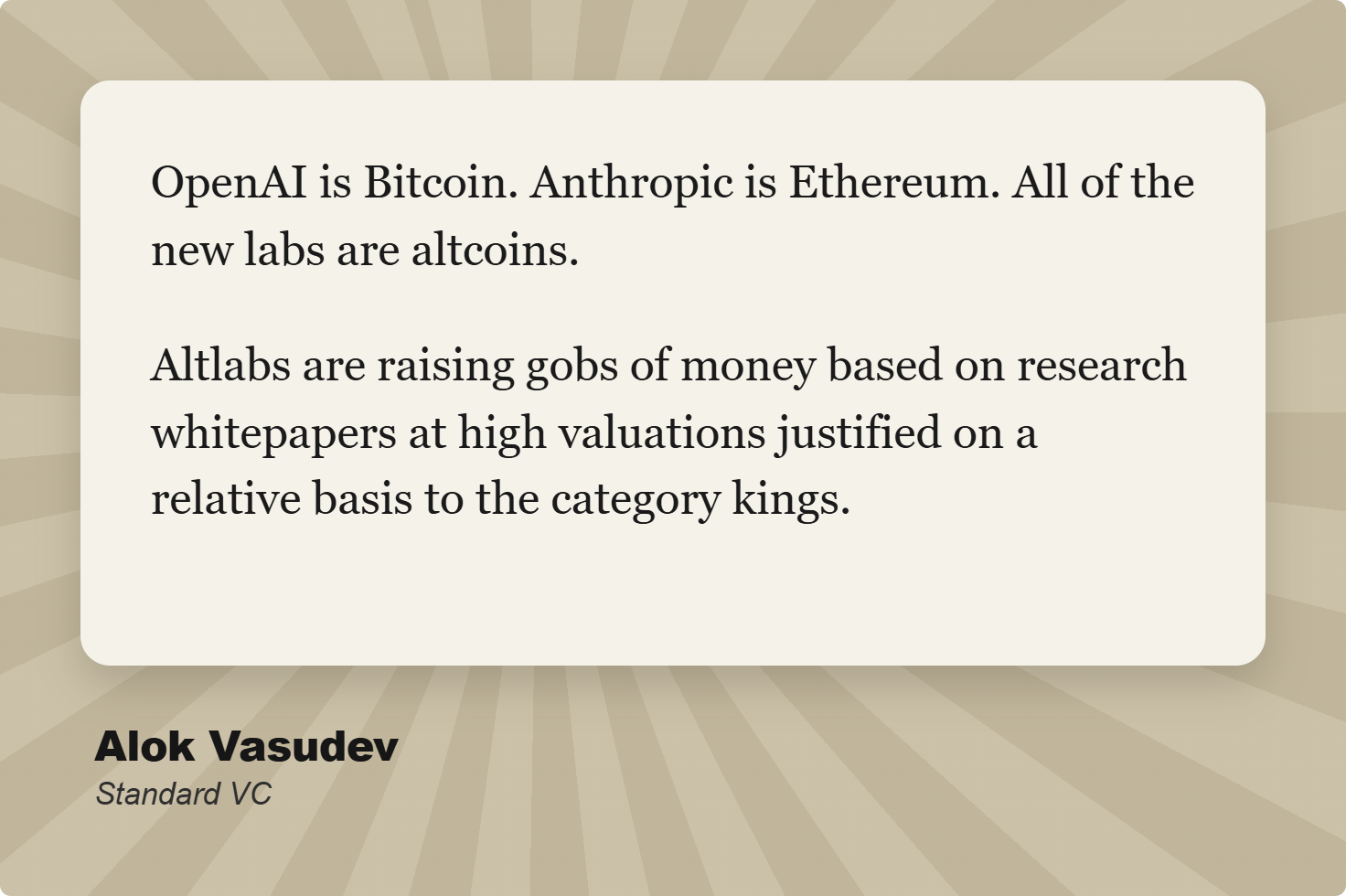
Vasudev maps the labs onto the last base-layer cycle: OpenAI is Bitcoin, Anthropic is Ethereum, and the rest are altcoins, raised on research reputations at valuations set by the leaders.
The mechanics rhyme, from a talent-and-novelty funding rush to a capital-heavy build in which last cycle’s miners became this cycle’s “neoclouds,” such as Coreweave and Crusoe.
The difference is liquidity. Tokens traded at launch, while a lab has to build a business and earn its exit the slow way.
Our Takeaway:
The analogy earns its keep because the earlier cycle already wrote the ending. Most base-layer projects went nowhere, a handful reached a stubborn second tier, and one or two broke out, so the rational play was to fund the whole field, which is roughly what AI venture is doing now.
The divergence is the warning. Lacking the token’s built-in exit, the median lab’s likeliest outcome is a down round rather than a windfall, and the real returns concentrate in a few names.
For an operator the lesson is to stop fighting the base layer. If the labs are the new L1s, the durable businesses sit in the applications and rails above them, as they did on-chain after 2021.
The deeper rhyme is abundance. Last cycle’s L1 race produced a glut of cheap blockspace, and value moved to whatever stayed scarce around it: stablecoins, distribution, the apps with users. If the labs commoditize intelligence the same way, the scarce inputs become energy, compute, and the applications on top, not the models in the middle.
#3 Your AI Agent Is a Nobody. And That’s a Problem.
Author: Mike Blandina (CIO of Snowflake)
TLDR:
Blandina argues the constraint on enterprise AI is no longer capability but accountability. An agent can query a database, flag a risk or initiate a transaction, yet when something goes wrong there is often no record of who created it, what it was allowed to do, or what it touched.
He calls this the “agent identity problem.” Traditional identity assumes stable roles and fixed access, but an agent may spin up for one task, pull from four data sources, combine them into a derived insight no one authorized, and vanish by noon, leaving no audit trail.
His fix is to build governance into the architecture rather than bolt it on: scoped identity set at creation with an expiry, policy that follows the agent’s outputs and not only its inputs, and a permanent record that outlives the agent. Snowflake’s own assistant, he notes, answers more than 35,000 questions a week for over 6,000 staff while staying auditable after the fact.
Our Takeaway:
The word the piece never quite says is liability. Once an agent can move money or delete records, someone has to answer for its mistakes, and “the model did it” is not a defense a regulator, a court, or an insurer will accept.
That turns agent identity from a compliance chore into the precondition for insurance, because no one underwrites a risk they cannot reconstruct. A verifiable identity and a tamper-evident log of what an agent did, and on whose authority, is what lets an actuary rather than a nervous general counsel sign off, and the on-chain version of that log is the one no single vendor has to be trusted to keep.
Watch the insurers and the auditors, not the model labs. The first carrier to write an “agent errors and omissions” policy, or the first audit firm to certify an agent’s actions, prices the trust layer in dollars, and that figure will standardize agent identity faster than any protocol announcement.
The 3-2-1 🔍
Featured insight breaking down a major story or trend that matters
The Rebel Alliance (Part 2)
Author: Nick Grossman (Partner, Union Square Ventures)
TLDR:
USV has published this thesis twice. The original “Rebel Alliance” came from Grace Carney with ex/ante in July 2025; this is Grossman’s June 2026 sequel, which keeps the name but draws the full market map and, a year on, backs it with the traction the first piece could only forecast. The market is pricing what Grossman calls a “Fat Models” world, in which a few vertically integrated firms own the model, the interfaces, the orchestration, the agents and the apps, and earn near-trillion-dollar valuations for it. Union Square Ventures takes the other side. It argues that the agentic stack will come apart into a “Rebel Alliance” of specialized layers: models, orchestration, memory, an agent browser, routing, identity and payments. The best product at each, it reckons, comes from a team obsessed with that layer, not from a conglomerate trying to hold them all.
The case rests on precedent and mechanics. Integrated stacks tend to come apart: the mainframe gave way to the personal computer, the desktop to the web, Apple’s integration to Android’s majority share, and Amazon Web Services to the ecosystem of large firms built on top of it. The pressures are visible now. Frontier models are separated by single-digit margins on the commercial work that pays, so buyers route across several rather than marry one; enterprises moving agents into production want parts they can swap and audit; and because agents are inherently cross-service, they force open interfaces, which reward specialists. Grossman names cryptographic identity and agent-first payments as first-class layers of that stack.
Our Takeaway:
Everyone is keeping score on the model fight, OpenAI against Anthropic against Google, as if the winner takes the whole stack. It is the wrong scoreboard. We have argued in these pages for a year that value drains from the model into the layers above it, and the market has now obliged: of the $37bn enterprises spent on generative AI in 2025, applications took $19bn against the $12.5bn that went to the model APIs underneath, and Grossman’s “Rebel Alliance” is the map of where it landed. The open question is, of all the layers climbing the stack, which single one actually compounds?
It is a layer that never had to exist on its own before, because in a human it doesn’t. A person carries three things at once when they buy: the intent, the authority to act on it, and the liability when the purchase goes wrong. An agent pulls them apart. It supplies the intent, you are left holding the liability, and the authority that used to bind the two has nowhere to live. That orphaned layer, authorization, is the keystone, and it is worth more than the model precisely because the model is becoming swappable while the liability never will be.
How it gets priced is the part almost nobody is watching. Identity for agents will not be settled by a standards body or a protocol launch; it will be settled by an actuary. Blandina’s point at Snowflake, that no one underwrites a risk they cannot reconstruct, is the whole game, because the first carrier willing to write an agent “errors and omissions” policy has to put a number on a verifiable identity and a tamper-evident record of what the agent did and on whose say-so. That figure is what standardizes the layer, since every firm putting an agent into production prices against it. The trust layer becomes real the day it becomes insurable.
The strongest objection, and Nadella makes it well, is that the incumbents swallow this layer the way they swallow everything, and Visa, Mastercard and Stripe are already shipping agent rails on their own Web2 signatures to prove it. It is a fair case, and on payments they may well win. But authorization is the one rung an incumbent cannot privatize, for the reason a clearing house belongs to no single bank: an agent that touches a dozen services will not route its liability through one platform’s private ledger. The tell is in what the incumbents do, not what they say, and Mastercard’s own agent product settles in stablecoins. They are not annexing the layer so much as queuing to underwrite on top of it.
So we land bullish on direction and honest about timing. The signal to track is not the next payments-volume chart; it is the first agent policy an insurer is willing to price. Our bet: before the end of 2026, a carrier or audit firm puts a dollar figure on agent identity, and that number moves the market faster than any protocol announcement. If agent commerce keeps scaling and still no one will write that policy, the liability gap is wider than the bulls admit, and the thesis is early by years. Either way, the model was never the prize. The layer that decides what an agent may do, and answers for it when it is wrong, ends up worth more than the intelligence it governs, and no one has put a price on it yet.
Power Quote:
We believe that the AI opportunity is too big and too important to be owned by any one company.
What We’re Downloading 🎧
Podcasts, interviews, discussions, and research reports that are influencing our thinking
IC3, the academic blockchain initiative at Cornell Tech, has published a 700-source survey of the AI and blockchain intersection. Its most striking figure: about half of all Ethereum blocks are already built with trusted computing, and confidential inference on an NVIDIA H100 carries under 7% in overhead.
“An Ex-OpenAI Researcher on the Real Risk of Frontier Models,” an interview with Yash Patil, founder of Applied Compute, which is Nadella’s “token capital” argument made concrete: the case for training custom models on a company’s own data.
South Park Commons, “Trusting Your Agent Is Overrated,” by Ryan Atkins, the clearest framework we have read for why opacity, rather than capability, is the real constraint on agent adoption.
Tweet of the Month 🐦
Key takeaways and perspectives from X
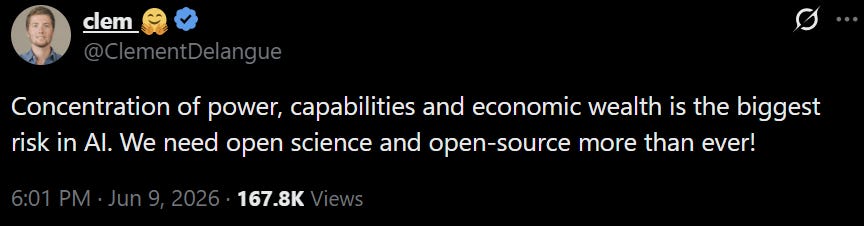
Clement Delangue (Co-Founder and CEO, Hugging Face)
Meme of the Month 📸
Send us your memes for a chance to be featured: hello@321converge.com

See you next month,
Nick Tang
X: 0xtangelo
Kris Jenk
X: 0xjinkys
Follow 321 on X @321Converge
Suggest an article or blog post for next month’s Convergence here.