Project Hail Human
A rescue mission for human agency in the agentic web is underway


AI agents are starting to feel less like software features and more like citizens of the internet. They browse, buy, compare, negotiate, migrate data, and increasingly act on our behalf. But the web they are entering was not built for autonomous actors. It was built for human clicks, human attention, human ads, and platform-controlled identity.
That mismatch is becoming the next great internet conflict. Platforms want to know whether the visitor is a person, a bot, or an agent acting for one.
The most convenient solution is surveillance with behavioral biometrics, tighter identity gates, and more systems that make humans prove themselves through the way they move, type, speak, and behave. The better solution is with blockchain infrastructure: cryptographic proofs, portable identities, delegated wallets, verifiable reputations, and user-owned contexts.
Ryan Gosling’s recent Project Hail Mary film is a survival story that follows a man who wakes up alone in space and has to reverse engineer a crisis large enough to threaten humanity. It is a strong parallel to where the internet is headed now.
We’re calling this issue Project Hail Human. The rescue mission ahead is preserving human agency as the internet fills with non-human actors. What happens when agents become the new browsers, when reputation becomes the new brand, and whether humans own the stack underneath it or get owned by it.
Convergence is brought to you by 321 Converge Inc. (“321”), a new 501c6 created by the founders of The Medici Network.
Integrations We Want To See 🔮
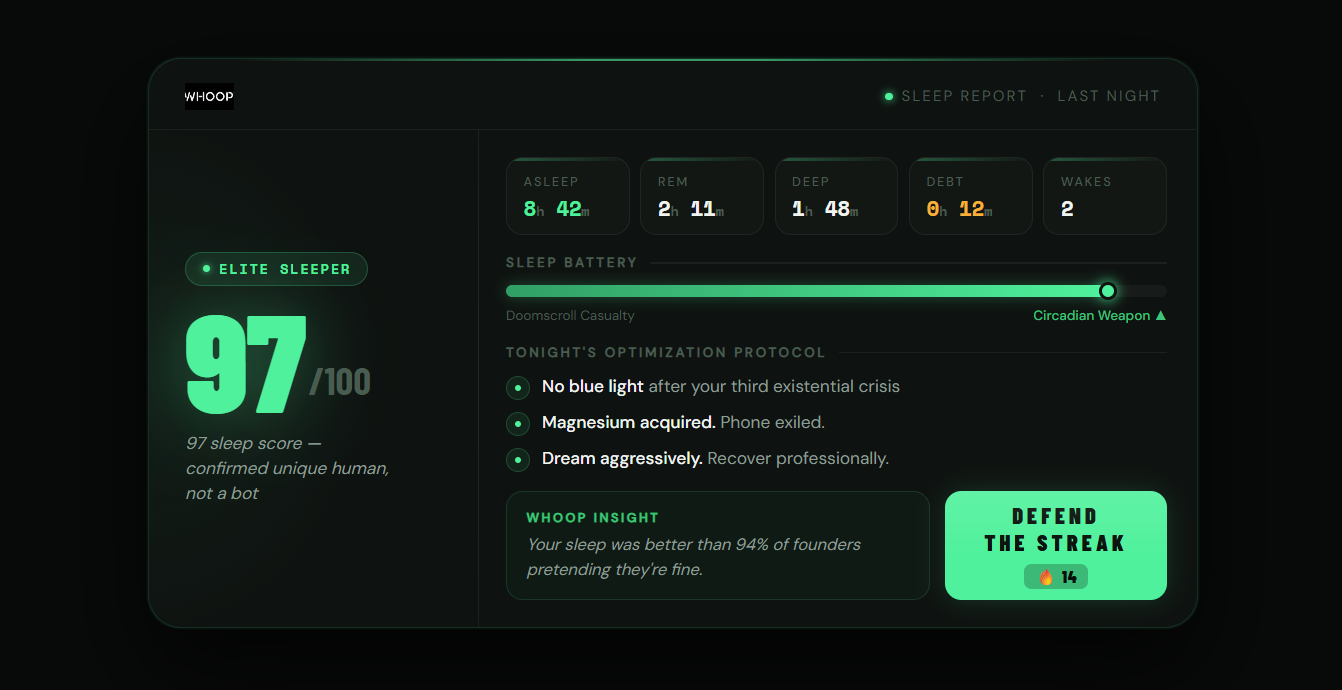
Now that we own our data, here are some things we’ll do with it
Sparks ✨
Quick, curated Web2 and Web3 insights you need to know
#1 Some Simple Economics of AGI
Author: Christian Catalini (Co-Founder & CSO of Lightspark, Founder of MIT Cryptoeconomics Lab, Co-Creator of Diem / Libra), Xiang Hui (Associate Professor of Marketing at Washington University’s Olin Business School), and Jane Wu (Assistant Professor of Strategy at UCLA Anderson School of Management)

TLDR:
AI is changing the economy by driving the cost of execution towards zero and as execution gets cheaper, the bottleneck won’t be intelligence. It will be human verification bandwidth (i.e. the scarce ability to validate outcomes, audit agent behavior, and assign responsibility)
Value will shift toward verification-grade ground truth, cryptographic provenance, and liability underwriting
Humanity must scale verification bandwidth alongside execution capacity so AGI preserves the human intent and agency that created it, otherwise we risk trending towards a “Hollow Economy”
Our Takeaway:
Autonomous agents need neutral rails for identity, payments, reputation, escrow, and auditability because agents require shared trust infrastructure that no single platform should own. Blockchains are the perfect neutral rails to provide agents with portable identity, programmable settlement, verifiable history, and enforceable transaction logic
When every company can generate code, content, analysis, emails, contracts, and decisions at near-zero marginal cost, the premium shifts from creation to verification. Important factors are knowing who authorized the output, what data was used, which model ran, what constraints were applied, and who is liable if it fails
Brand trust is too slow. Legal enforcement is too expensive. Platform APIs are too permissioned. Cryptographic attestations are the natural primitive for a world where software is acting continuously on behalf of humans
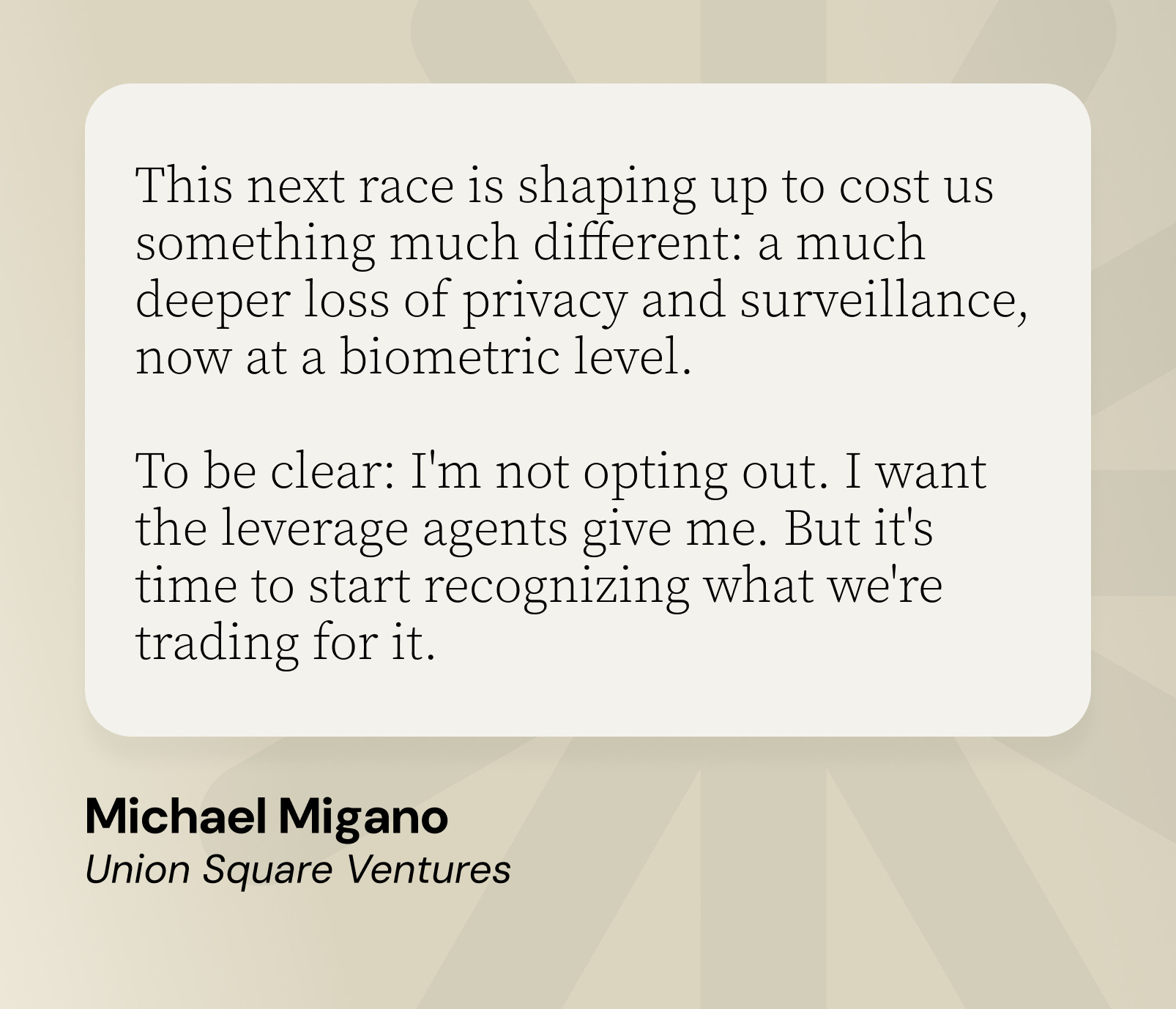
#2 The Biometric Web
Author: Michael Mignano (General Partner at Union Square Ventures)

TLDR:
Personal agents are becoming useful enough for people to route more digital work through them, but websites are increasingly detecting and blocking them as non-human automation because their “behavioral texture” looks different (e.g. smoother mouse movement, fewer hesitations, fewer human mistakes), despite completing the same tasks a human would complete on the same browser, session, and app surfaces
A new major arms race of the open web is arising, pushing platforms and CDNs toward agent detection. The first web bot war was against scrapers. The second moved to CAPTCHAs. The third may move to behavioral biometrics (i.e. proving humanness through how we move, type, speak, look, and hesitate)
The web may become a biometric layer to preserve existing internet businesses because platforms are incentivized to keep humans directly using products because ads, subscriptions, and other businesses models depend on human engagement
Our Takeaway:
Agent adoption is creating a new privacy bargain: convenience in exchange for embodiment. The old web tracked what we did (e.g. what we clicked, bought, searched, and watched). The agentic web is tracking how we act (e.g. how we move a mouse, pause before clicking, scroll, type, make mistakes, etc.)
As AI agents make bot detection harder, platforms face two paths. The first is passive inference where CDNs, browsers, and apps decide whether we are human by continuously monitoring behavioral signals. The second is user-controlled verification where people and their AI agents carry explicit credentials that prove only what is necessary
Companies like Venice AI are the user-side response to the agentic web. Users are gravitating toward AI products that do not turn their prompts, memory, and context into platform-owned data. The blockchain-related privacy app recently crossed 3 million users by offering a simple alternative to centralized AI that includes local conversation storage, private-by-default inference, and access to both open- and closed-source models
#3 The Brand Age
Author: Paul Graham (Co-Founder of Y Combinator)

TLDR:
Brands are becoming more important because the world is getting noisier, more automated, and harder to evaluate directly. In markets where products are abundant and information is overwhelming, a brand becomes a shortcut for trust. It tells people what to believe before they have time to inspect every claim
That matters even more in the AI era. When content, software, services, and even companies can be generated or cloned quickly, the scarce asset is not production. It is credibility. The more everything becomes easy to make, the more valuable it becomes to know what is real, who stands behind it, and whether a history of behavior can be trusted
The brand, in this framing, is not just a logo or marketing layer. It is compressed reputation. It is the market’s memory of whether you consistently delivered
Our Takeaway:
Reputation is increasingly becoming the asset that matters most. But today, reputation mostly lives inside platforms. Your Uber rating, Airbnb history, Stripe transaction record, Shopify store data, Twitter following, GitHub contributions, and marketplace reviews all exist in separate silos. Each platform lends you reputation, but none of them truly lets you truly own it
Web3 changes the surface area of brand. A brand no longer has to be only a company-level abstraction. Thanks to cryptographic technologies such as zkTLS, reputations can become portable, composable, and user-owned. As AI makes imitation cheap, the harder it becomes to tell what is authentic and the more valuable verifiable history becomes
Brand and reputation are converging. A brand is what the market believes about you. Reputation is the proof trail that belief rests on. Web2 built brands through distribution and repetition. Web3 can build brands through verifiable behavior
The 3-2-1 🔍
Featured insight breaking down a major story or trend that matters
Magnifica Humanitas
Author: Pope Leo XIV
TLDR:
Artificial intelligence is the defining “new thing” of our time — a technological shift powerful enough to force a new moral and social framework. The Pope is not anti-technology, but argues that technology is never neutral. Technology reflects the incentives, values, and power structures of the people and institutions that design, finance, regulate, and deploy it. AI, therefore, is not merely a tool we use but an architecture that can quietly reshape what we value, how we relate to one another, and who gets to exercise power.
The central metaphor is Babel versus Jerusalem. Babel represents centralized technical power: one language, one system, one tower, one vision of progress that reduces people into inputs. Jerusalem represents shared responsibility: many participants rebuilding the city together, with human dignity, pluralism, solidarity, and the common good at the center. AI carries both promise and danger. It can heal, educate, connect, and protect, but it can also concentrate power, deepen inequality, distort truth, and make human beings more governable than free.
AI does not simply automate tasks. It can reorganize the conditions of human life. When knowledge, language, memory, creativity, and decision-making are mediated by machines, who shapes the mediation? If AI is built around extraction, surveillance, persuasion, and control, it risks narrowing the human person into a predictable object to be managed. But if it is built around participation, accountability, and care, it can become an instrument of human flourishing. We are at a critical inflection point of determining whether the systems beneath AI are ordered toward domination or communion.
The encyclical’s most important warning is that AI should not be judged only by capability or efficiency. It should be judged by what kind of human world it builds. Does it preserve truth as a common good? Does it protect work, freedom, and dignity? Does it empower the vulnerable, or does it give already-powerful institutions even more control over identity, labor, communication, and imagination? There is no question that humanity will build with AI. The question is whether we are building Babel, a tower of centralized power, or Jerusalem, a city worthy of the human person.
Our Takeaway:
Cryptography and blockchain are not mentioned explicitly in Magnifica Humanitas, but their relevance is everywhere beneath the surface. The encyclical is really about the architecture of power. Who gets to define truth? Who controls identity? Who owns the data exhaust of human life? Do technological systems make people more free or more governable?
That is exactly why blockchain primitives matter in the AI age. If AI becomes the interface to the internet, then the most important layer is no longer just the model. It is the trust layer around the model which include identity, provenance, permissioning, ownership, verification, and value transfer.
Portable identity prevents users from being trapped inside one AI platform’s memory. Verifiable credentials let people prove things about themselves without exposing everything about themselves. Cryptographic provenance helps distinguish authentic content, authorized agents, and manipulated media. Stablecoin rails let agents transact without relying on human-era payment systems. User-owned data gives individuals leverage in a world where context becomes the moat.
The Pope’s Babel-versus-Jerusalem metaphor maps cleanly onto the next internet. Babel is a centralized AI stack: one interface, one identity system, one memory layer, one set of opaque rules, and one company deciding what humans and agents can do. Jerusalem is an open, verifiable internet: many participants, shared infrastructure, portable rights, cryptographic accountability, and coordination without total dependence on a single platform.
Web3 is not just a financial alternative. It is a governance technology for the agentic web. The next internet needs to make humans more sovereign, not merely more measurable.
Power Quote:
Today, however, the main drivers of development are private, often transnational, parties that are endowed with resources and the capacity to intervene that surpass those of many Governments. Technological power thus takes on an unprecedented, predominantly “private” aspect, which makes it even more challenging to discern, govern and direct such power toward the common good.
What We’re Downloading 🎧
Podcasts, interviews, discussions, and research reports that are influencing our thinking
Tweet of the Month 🐦
Key takeaways and perspectives from X
Paul Graham (Co-Founder of Y Combinator)

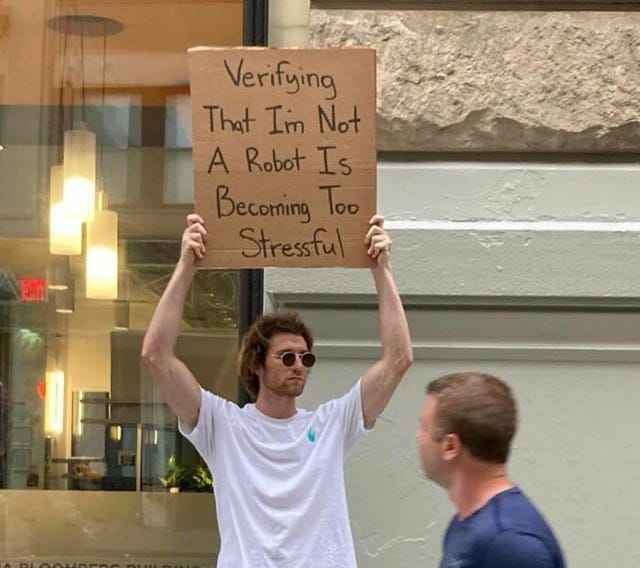
Meme of the Month 📸
Send us your memes for a chance to be featured: hello@321converge.com
See you next month,
Nick Tang
X: 0xtangelo
Kris Jenk
X: 0xjinkys
Follow 321 on X @321Converge
Suggest an article or blog post for next month’s Convergence here.