
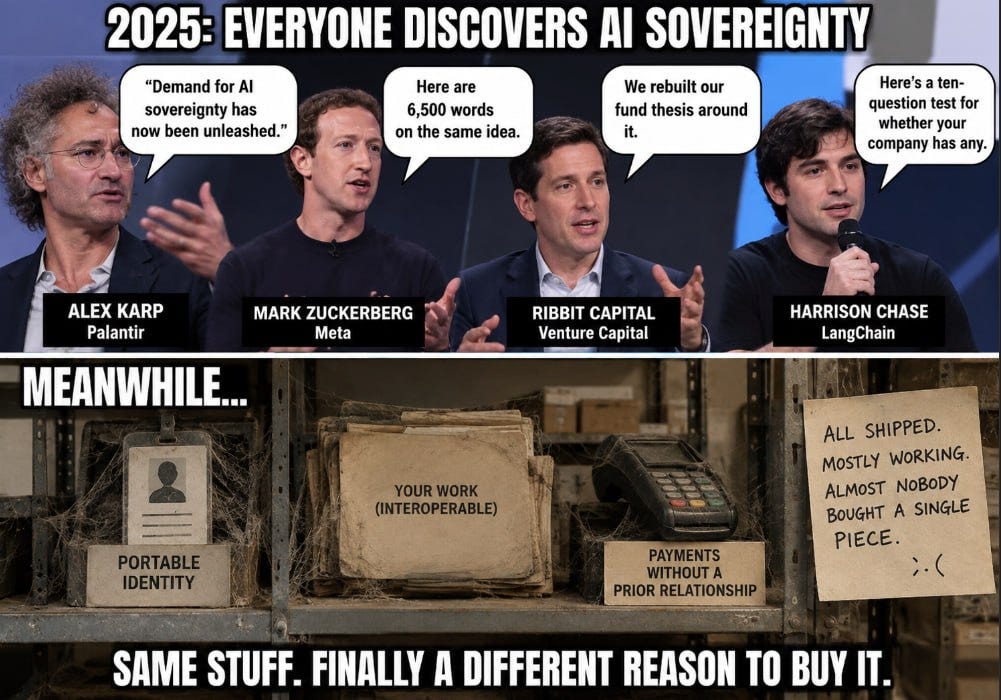
Palantir’s Alex Karp told investors on 3 August that his quarter had one cause. “Demand for AI sovereignty has now been unleashed,” he said. Within six weeks Mark Zuckerberg published 6,500 words on the same idea, Ribbit Capital rebuilt a fund thesis around it, and LangChain’s Harrison Chase shipped a ten-question test for whether your company has any.
Everything those four are asking for already exists and has for years. Those things are an identity that outlives the vendor, a record of your work that can move, and payment that doesn’t need a relationship. All of it has already been shipped, but it’s not being bought.
Welcome to Convergence! Subscribe for free to receive new posts directly to your inbox.
Convergence is brought to you by 321 Converge Inc. (“321”), a new 501c6 created by the founders of The Medici Network.
Sparks ✨
Quick, curated Web2 and Web3 insights you need to know
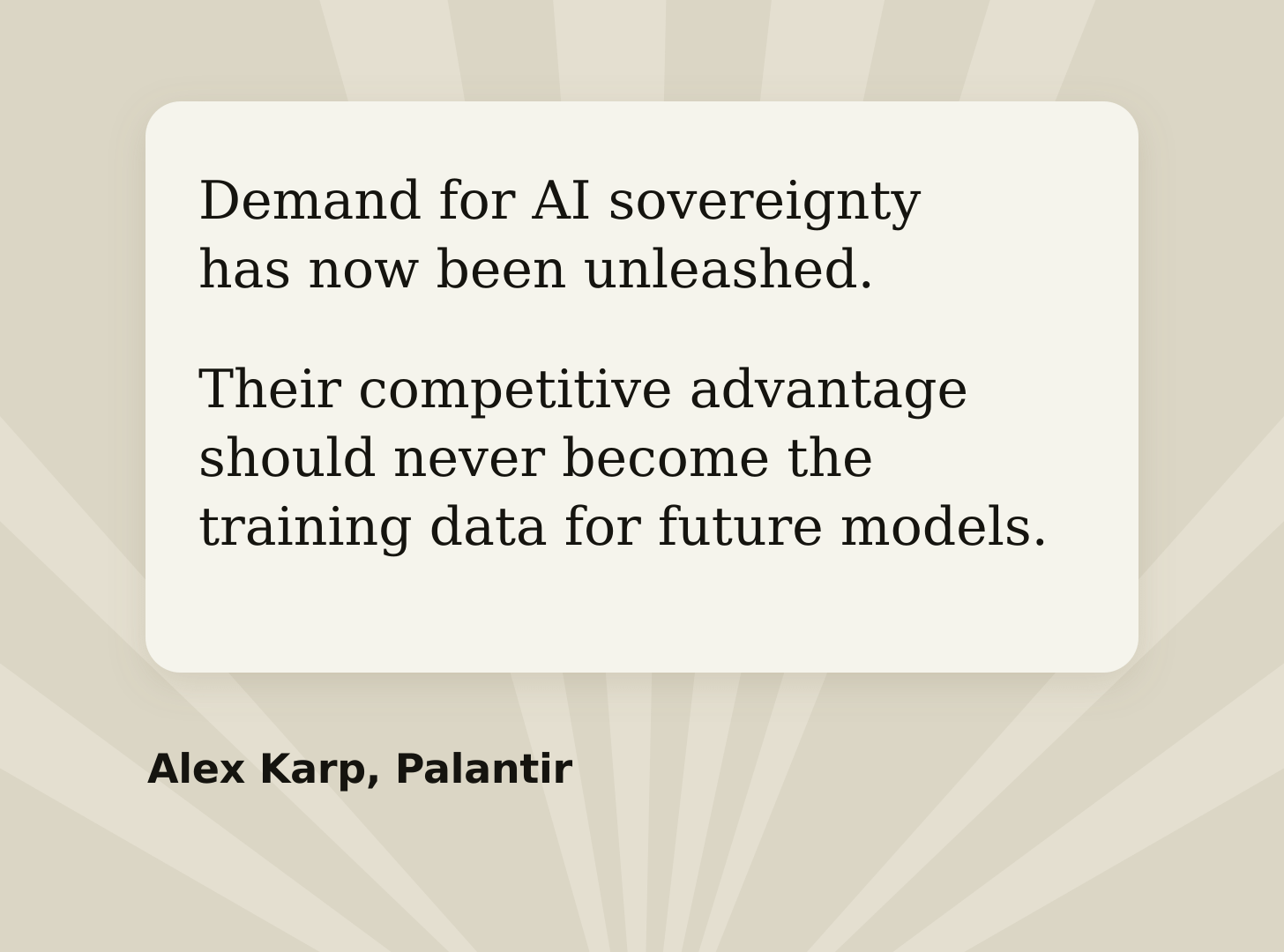
#1 Institutional Sovereignty in the Age of AI
Author: Alex Karp (CEO, Palantir)

TLDR:
Palantir says that the vendor processing your operations is also learning them, and the advantage you built is quietly becoming somebody else’s training set
Its fifteen recommendations come down to three ideas. Keep your data and your models inside infrastructure you control, refuse contracts that let a vendor learn from your operations, and treat the ability to switch providers as a security requirement rather than a procurement preference
“Their competitive advantage should never become the training data for future models”
Our Takeaway:
Companies have carried this concern for ~2 years, and Palantir booked $2.13B in US commercial contracts in a single quarter (vs. $764M of US commercial revenue in the same period) selling the solution. Given this, sovereignty has moved from a concern to a budget line
The difficulty is that no buyer can currently verify the remedy works. OpenAI, Anthropic, Google and Microsoft each commit in writing not to train on enterprise data, though none of them provides a way for a customer to check
The General Services Administration (the federal purchasing agency) published a draft clause in June barring contractors from using government data to train or improve their models, with comments closing in August. In contrast to the contractual route, Intel and Nvidia demonstrated hardware attestation, where the chip certifies which code touched a workload, and Attestable came out of stealth in August with a $20M seed (TLV Partners, Altimeter) to do the same with zero-knowledge proofs, on the argument that a buyer should not have to trust the chipmaker either. Either way, we expect the premium to accrue to whoever issues the certificate rather than whoever makes the claim
#2 The Future is for Everyone
Author: Mark Zuckerberg (CEO of Meta)

TLDR:
Zuckerberg argues the real question is who gets to point superintelligence at things, and that locking it inside a few institutions is itself the danger. A shorter version ran as a WSJ op-ed in late July
His alternative to alignment is balance of power. One person with a superintelligent lawyer is a problem. Everyone with one is a functioning court
He commits Meta to resuming some open-source releases, proposes an auction that gets users the cheapest available compute, and asks Washington to stop restricting open models
Our Takeaway:
Weights, auction-priced compute and personal agents are all capability, and all of them are on the table. The social graph, the memory and the record of what any of it did are not mentioned once. Capability is what Meta gives away and the record is what Meta keeps, which is consistent with it buying companies that hold exactly that
The policy section shows what the philosophy is for. The concrete ask is that Washington stop restricting open models, foreign ones included, which in practice means Meta’s freedom to build on Chinese open weights
The model layer is a poor place for a builder to compete. Meta is not alone in wanting capability commoditized - every lab except OpenAI and Anthropic has a reason to push open weights - and when that many well-funded parties want a layer to be free, it will be
#3 The Ribbit Power Letter
Author: Ribbit Capital

TLDR:
Ribbit’s July letter argues the thing holding AI back stopped being money and became electrons, and the industry meant to supply them spends less of its revenue on R&D than the average restaurant chain
The US added 53GW of new power capacity in 2025, its biggest year since 2002, with roughly 86GW planned for 2026. For scale, a large nuclear reactor produces about 1GW, so last year the country added the equivalent of about fifty of them and still can’t keep up with demand
The four biggest hyperscalers guided to roughly $650B of capital spending this year against about $570B the world put into oil and gas exploration (IEA), with no reference price and nothing to hedge with
Our Takeaway:
Ribbit is a fintech firm (Robinhood, Nubank, Revolut) ~14 years in, and it has now published 40 pages on electricity. We read this less as a change of subject than as a financial investor recognizing that compute is becoming a tradable asset before it has finished becoming an industrial one
In every commodity market the durable margin accrues to the clearer and the index provider rather than the producer. Because of this, the names worth tracking are not the power developers but Silicon Data, whose GPU indices are already distributed on Bloomberg and Refinitiv, and Ornn, which raised $33M (led by a16z) and publishes a compute price index built on real trades. CME and ICE intend to settle their contracts against those numbers
Building a market from scratch also allows for a choice of plumbing that incumbents cannot retrofit. MNX runs 200-millisecond batch auctions rather than a continuous order book, so every order in a window clears at one uniform price and the latency race that funds high-frequency trading stops paying
The 3-2-1 🔍
Featured insight breaking down a major story or trend that matters
Frontier Internet: Crypto’s Final Act
Author: Imran Khan (Co-Founder of Alliance)
TLDR:
Khan goes back to the thesis Chris Dixon laid out in Read Write Own: platforms eventually turn on their users, and open protocols could hand identity, data and economics back to the people generating them. He says Dixon had the direction right. Then he concedes that nobody cared. People handed Google, Apple, Amazon and OpenAI their data because those products were easy, and no argument about who owns your social graph has ever beaten a product that just works.
His answer is that the ownership layer was built correctly for the wrong customer. Agents deal with thousands of services they have never met and cannot negotiate a separate relationship with each one, so portability stops being a nice idea and becomes the only way the thing functions. He points to Cloudflare’s finding that automated traffic now outnumbers human traffic on the web as evidence that this constituency has already arrived.
The forward half of the essay is the more interesting one. Khan sketches what he calls the frontier internet as five layers that only work together: AI as the intelligence layer, blockchains as the economic and ownership layer, robotics connecting both to the physical world, and compute and energy as the resources underneath. In that picture agents need persistent identities and reputations they carry between jobs, storage where a second agent can verify it received exactly what a first agent published, and markets they can reach without a commercial relationship. He is careful about the claim. This is not decentralization for its own sake, and he expects on-chain storage and identity to run alongside AWS rather than replace it.
Our Takeaway:
Let’s start with why nobody bought it. The ownership layer didn’t fail because it was badly built. It failed because it cost too much for the problem it solved. Every company knows that problem: you leave a vendor, your data comes with you, and your history stays behind. The tickets, the tuning, the record of what you already tried all sit in a system you no longer pay for while the new vendor starts you at zero. For a decade almost nobody bought the fix, because if you switch vendors once every four years you aren’t paying extra today to make year four easier.
The consumer verdict was even more decisive. Farcaster, a social network where your account and your followers live on a blockchain rather than on the company’s servers, is the best consumer product ever built on portable identity. It peaked near 100,000 daily users in mid-2024 and fell under 20,000 monthly by late 2025. Bluesky offers roughly the same social experience with none of the ownership machinery underneath, and it still had 10.4M monthly users in June even after dropping 27.2% in a year. Both are shrinking. People were offered ownership, chose the faster product, and the industry spent ten years calling that a marketing failure when it was a price.
So what changed? Not the product, and this is where we would push on Khan. Agents don’t want anything. An agent has no preference about portable identity because an agent has no preferences at all. The company deploying it is the one that doesn’t want to re-earn six months of standing every time it switches vendors. The customer is the same enterprise buyer it always was. What changed is how often that buyer has to switch, and a cost that was an annoyance at human speed becomes a line item at machine speed.
The evidence for that is a number most people read as failure. x402 is a payment standard that revived an unused corner of the web’s original design, the “402 Payment Required” error code, so software can pay for something the moment it needs it. Because the headline counts were inflated by retries, self-payments and repeat traffic, the data firm Artemis built a filter with Visa to strip those out, and Visa’s head of digital assets put the cleaned figure at roughly 134M transactions carrying about $19M in total at ~14 cents each.
As a payments business, that is a disaster. As a measurement of something else, it is significant. Those transactions are that many occasions when a piece of software had to establish terms with a counterparty it had never met, and the direction is worth taking into account. Artemis logged real x402 transactions hitting an all-time high of roughly 2.2 million in a single day in late August. The dollars tell you the market is early. The count tells you the underlying math already moved. Akash shows the same shape from the compute side, with more leases at a lower price, and two unrelated markets moving that way at once is a signal rather than a coincidence.
The platforms have noticed, and what they are doing is more specific than simply closing the gates. Meta bought Moltbook, a forum where AI agents post to each other, forty-one days after launch and before anyone could verify its traffic, which a security researcher later found was 1.5M API keys behind about 6,000 real operator emails. In the same stretch Google gave A2A away to the Linux Foundation and Anthropic gave the Model Context Protocol to a new Agentic AI Foundation, whose platinum members are AWS, Google, Microsoft and OpenAI. That is commoditize your complement, Joel Spolsky’s old rule, running at speed. Give away the layer that could trap you, and buy the layer that could trap someone else. The protocols are free now, and a neutral place for agents to meet is the one thing nobody donated.
The fair objection is that agents already work fine inside ordinary corporate permissions, and Gartner expects more than 40% of agentic AI projects to be cancelled by the end of 2027. Both true. But every spending limit an agent operates under today is handed down from a human balance sheet, and delegated authority is how credit always starts. A corporate card is a subdivided balance sheet. The moment worth watching is when the issuer starts pricing the cardholder instead.
So here is our call. By the end of 2027, at least one underwriter, lender or card issuer will price a limit against an agent’s own verified work history instead of its parent company’s balance sheet. The infrastructure is already sitting there. ERC-8004, a standard that gives an agent an identity and a reputation record that no single company controls, went live in January and had 554,344 agents registered by 5 September, and no lender or insurer has touched any of it. That is the moment a track record stops being a feature and becomes collateral. If we’re wrong, it will look like this: the credentials that matter in 2027 are a Meta login, a Google credential and a Visa token, and every record of what agents did sits inside those three companies.
The last ten years of platform arguments were about who owns the layer. This one is about what it costs, which is a question a finance team can answer. ~14 cents, 134 million times over, is a terrible quarter and a very good signal.
Power Quote:
The missing piece for this new architecture is agents, not humans
What We’re Downloading 🎧
Podcasts, interviews, discussions, and research reports that are influencing our thinking
Harrison Chase, “What does it mean to own your intelligence?” A ten-question audit of the AI stack a company controls. The hardest question is whether you can move what your agent learns to a different system.
Allison Duettmann, Foresight Institute, “Open Science Needs Open Compute.” Five hyperscalers hold an estimated 71% of the world’s AI compute. Her argument that open weights sit inert without hardware you control is the half of the openness debate that rarely gets made.
Matthew Green, “Some thoughts about Anthropic’s new cryptanalysis results.” A model produced a real key-recovery attack on a candidate post-quantum signature scheme using no exotic ingredients, and Green’s conclusion is the one to carry. Verification is now the constraint, and generation is cheap.
Ben Thompson, “The CapEx Train Keeps Rolling.” The spending case underneath everything above, and the clearest account of why every lab except OpenAI and Anthropic wants open-weight models.
Tweet of the Month 🐦
Key takeaways and perspectives from X
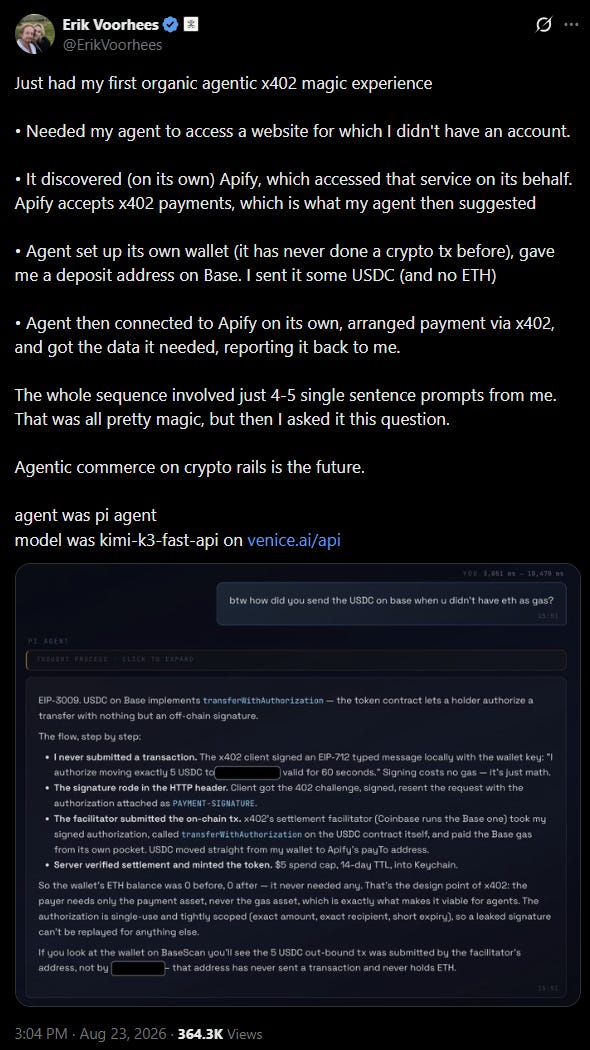
Erik Voorhees (Founder of Venice)
Meme of the Month 📸
Send us your memes for a chance to be featured: hello@321converge.com
See you next month,
Nick Tang
X: 0xtangelo
Kris Jenk
X: 0xjinkys
Follow 321 on X @321Converge
Suggest an article or blog post for next month’s Convergence here.