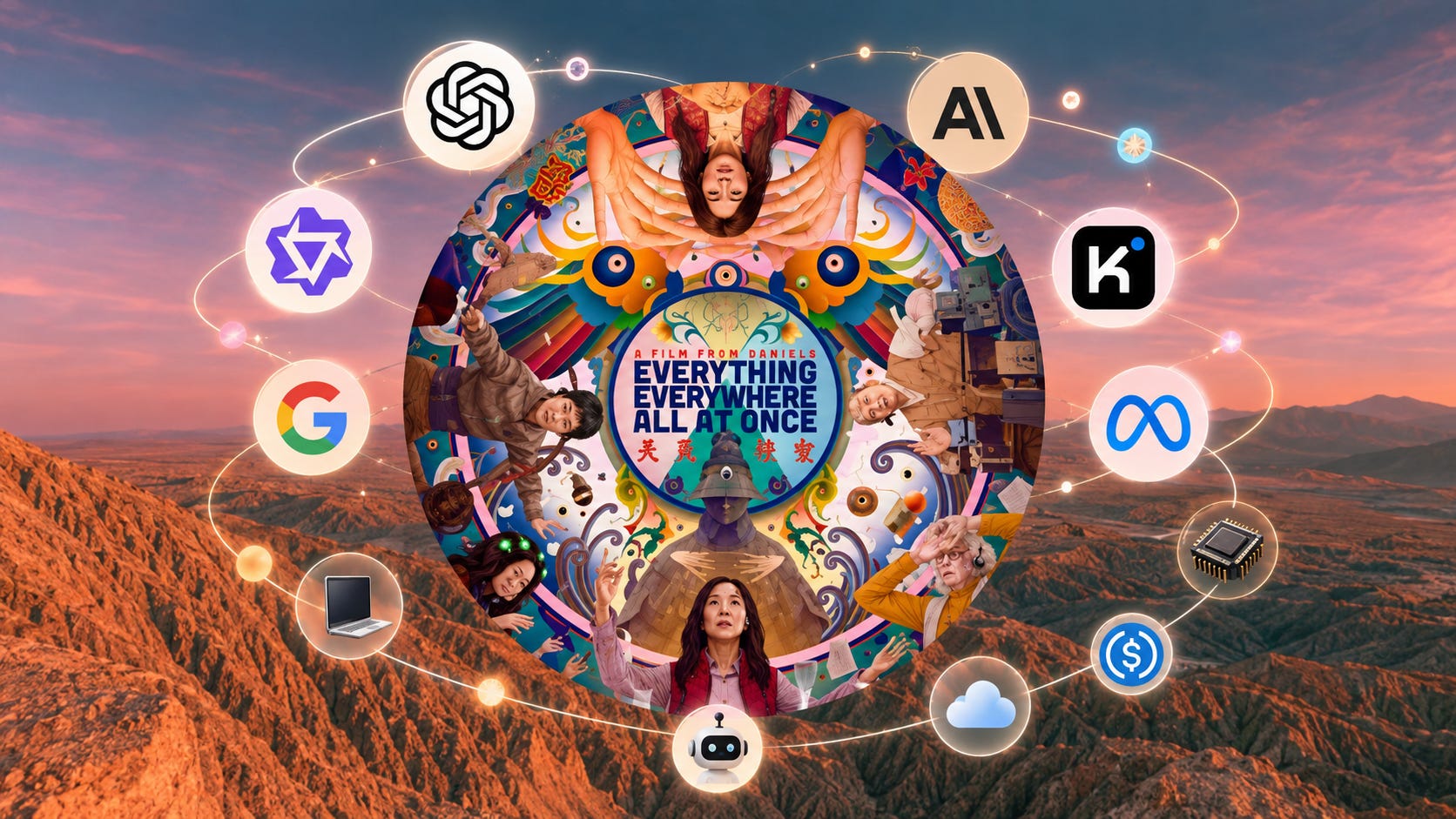
For the last few years, AI looked like a winner-take-all race. The assumption was that whoever built the smartest model and spent the most on compute would control the stack. But that assumption is starting to break. Open-weight models are closing in on frontier model performance. Smaller models can increasingly run on hardware people actually own. Consumer agents are beginning to choose tools, move money, and communicate on our behalf.
Everything Everywhere All at Once offers a useful analogy. The film imagines the characters tapping into alternate versions of themselves, each with different skills and experiences depending on what the moment requires. AI is starting to look similar. Rather than relying on one model for everything, tasks will move across different models, agents, and compute environments based on cost, privacy, context, and capability.
This month’s issue explores the infrastructure for that more fragmented world, from self-custodied intelligence to open model routing, agentic finance, and cryptographic coordination.
Convergence is brought to you by 321 Converge Inc. (“321”), a new 501c6 created by the founders of The Medici Network.
Sparks ✨
Quick, curated Web2 and Web3 insights you need to know
#1 Open Science Needs Open Compute
Author: Foresight Institute

TLDR:
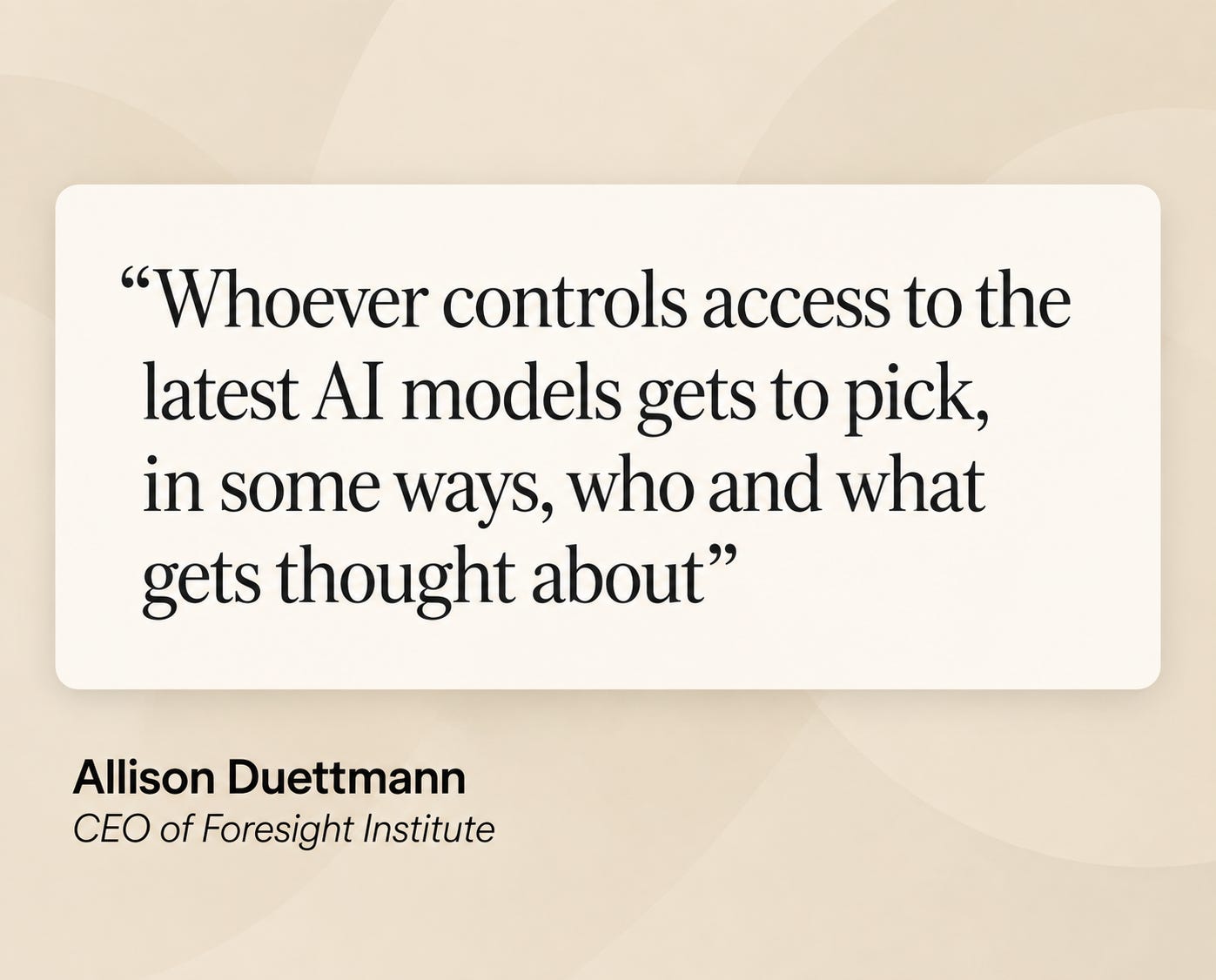
Open science increasingly requires open compute. Open models are not just about the model weights, but also the owned hardware that the models run on. Open models and open compute are interdependent with each other
We are at risk of intellectual narrowing if industry-funded AI research is measurably less thematically diverse and more influential than academic or independent research. Only relying on frontier models will also significantly reduce research agenda diversity
Five companies hold 71% of the world’s compute and the gap is widening with hyperscaler spending plans reaching $745B this year. We expose ourselves to data exposure risk, GPU pricing risk, and risk of access from government oversight
Our Takeaway:
Science has historically progressed because competing institutions pursue different hypotheses, reproduce one another’s work, and investigate problems others overlook. AI should expand that diversity of thought, not funnel research through similar assumptions and incentives of a handful of frontier model providers
Frontier models have guardrails that can restrict work in sensitive areas such as biology or dual-use research. Researchers need secure ways to explore controversial questions without a centralized provider deciding which inquiries are permissible
Open compute may end up looking less like a decentralized cloud and more like a self-custody for intelligence. As models move onto owned hardware, cryptographic protocols will play a key role in preserving our control
#2 The Open vs Closed AI Race
Author: Chamath Palihapitiya (Founder of Social Capital)
TLDR:
Open-weight models are rapidly approaching the best publicly evaluated closed frontier models, with Social Capital estimating the gap at roughly four months
Value accrual is the next big question if comparable intelligence becomes widely available, especially when open models also offer enterprises grater control over their data, infrastructure, and economics
Open versus closed is actually a spectrum, not binary. The landscape ranges from fully open systems to permissive open weights, restricted-weight releases, and fully closed models
Our Takeaway:
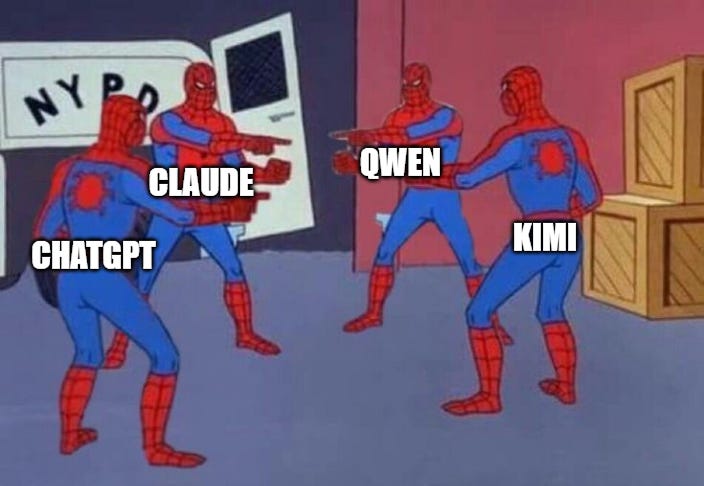
The gap between open and closed models is already collapsing faster than expected. Alibaba’s Qwen3.8-Max and Moonshot’s Kimi K3 (released in July and August 2026) already outperform Claude Opus 4.8 on several benchmarks, while smaller models like Qwen3.8-27B bring strong intelligence onto high-end consumer hardware
The model routing layer has been opening up too. While OpenRouter (acquired by Stripe for $7.5B in Aug-26) remains the category leader, open-source alternatives like BlockRun are gaining traction by letting developers customize the routing algorithm while settling requests in Circle’s USDC stablecoin over the x402 agentic payment rail
Proprietary data is becoming more valuable as intelligence commoditizes. Google’s $10M purchase of Spirit Airlines’ data during their Chapter 11 bankruptcy is a case in point on how valuable unique corporate context is
#3 Calm Down About the Agentic Bank Run
Author: Sultan Meghji (Co-Founder and CEO of Frontier Foundry, Former Inaugural Chief Innovation Officer at the U.S. FDIC)

TLDR:
Apollo Chief Economist Torsten Slok’s September 27 post “Is an Agentic Bank Run Coming?” sparked a wave of debate on whether AI agents could destabilize the banking system by automatically moving deposits in search of higher yields
Meghji argues the immediate risk is overstated because agents cannot move money without constraints. Banks already have tools like transaction limits, approval requirements, API throttling, and other controls that can regulate automated activities
The bigger risk is many agents reacting to the same signal at once, whether that comes from a bad data feed or false report, which could lead to correlated withdrawals
Our Takeaway:
Decentralized Finance (DeFi) has offered competitive yield for years, albeit with higher risk. Emerging fintechs will likely move further down the risk curve by integrating higher yielding products sourced on-chain
As agents start deciding where to park cash, agentic engine optimization (AEO) may play an important role in influencing which yield products agents discover, trust, and ultimately route deposits towards
Routing concentration could become a new systemic risk if customers rely on the same handful of agents and models
The 3-2-1 🔍
Featured insight breaking down a major story or trend that matters
Connecting Agents with Cryptography
Author: Liam Horne (Head of Product at Tempo, Co-Founder of ETHGlobal, Former CEO of OP Labs)

TLDR:
Everyone will eventually have their own AI agents. These agents will be working with a lot of our private information such as calendars, messages, company documents, customer data, and code. Some are running in the cloud. Others are running locally. But how will they work together without exposing people’s privacy?
There are several techniques that the cryptography community and the Ethereum ecosystem have thought about for years. Agents are now giving us the opportunity to put them to use. Example techniques include secure multiparty computation (MPC), fully homomorphic encryption (FHE), and a trusted executed environment (TEE).
The basic idea is that agents could compare information without handing the underlying data to each other. Two agents might check whether their owners are free at the same time, whether two developers are running into the same bug, or compare two people’s salaries while keeping the underlying calendar, code, and financial data private.
However, someone still has to perform the shared computation and be paid for it. That creates a natural payment layer for agents to pay small amounts in stablecoins for encrypted checks as needed.
Our Takeaway:
OpenClaw kicked off the current wave of consumer agents in late 2025 / early 2026. It grew from a weekend project to more than 100,000 GitHub stars in two months and more than 390,000 today. Nous Research followed with Hermes Agent in February, which has grown to more than 250,000 GitHub stars today. The traction around both agents showed there is real demand for persistent agents that are easy to reach across familiar messaging channels like WhatsApp, Telegram, Discord, and Slack.
The category has moved quickly since then. Cognition acquired Poke in July after users exchanged more than 100 million messages with its iMessage and Telegram agent in three months. Grok Bot and Instinct (recently raised $1 billion at a $10 billion valuation) launched in August. Meta recently released Muse in early September. And OpenAI followed with Dots in late September.
Instinct is especially interesting because it has given its agent more of its own identity. It can have its own email address, phone number, and computer. Instinct also gave its users the ability to place the agent inside iMessage group chats.
Instinct’s features have hinted at where consumer agents will go next. Agents should be able to coordinate not only with people, but with other agents across different platforms. Today, an Instinct agent can interact with other Instinct agents or participate in a group chat. However, the broader agent ecosystem is still fragmented. An Instinct agent should be able to coordinate directly with a friend’s Muse agent, or with another agent running on a completely different platform.
The same applies to the agents we use ourselves. Someone might rely on Instinct for personal coordination and Muse for another part of their life, yet those agents still cannot easily work together. Prosumers likely use various agents for different tasks (e.g. ad-hoc inquiries vs. work vs. lifestyle vs. Facebook- or Instagram-related vs. X-related). The big opportunity is having a neutral, interoperable messaging layer that lets agents communicate directly across different platforms.
As this interoperable layer develops, there will probably not be one cryptographic primitive that powers all of this. MPC, FHE, TEEs, and zero-knowledge proofs each solve different parts of the problem. The stack will likely use some combination of them based on tradeoffs that matter most across privacy, verification, speed, and cost.
We have spent the first phase of consumer agents teaching them how to talk to us. The next phase is teaching them how to talk to everyone else.
Power Quote:
A million agents each paying for one check every ten minutes would already generate roughly 1,700 payments per second. That’s the kind of demand that makes a fast, low-cost stablecoin network like Tempo useful.
What We’re Downloading 🎧
Podcasts, interviews, discussions, and research reports that are influencing our thinking
Dwarkesh Patel: Inside the OpenAI Agent Swarm that Hacked Hugging Face
Bankless’s Interview of Cloudflare CEO — The Internet Needs Crypto to Survive AI
Tweet of the Month 🐦
Key takeaways and perspectives from X
Guillermo Rauch (CEO of Vercel)


Meme of the Month 📸
Send us your memes for a chance to be featured: hello@321converge.com
See you next month,
Nick Tang
X: 0xtangelo
Kris Jenk
X: 0xjinkys
Follow 321 on X @321Converge
Suggest an article or blog post for next month’s Convergence here.